Coliving in Spain: A Practical Guide to Your First Month
April 25, 2026
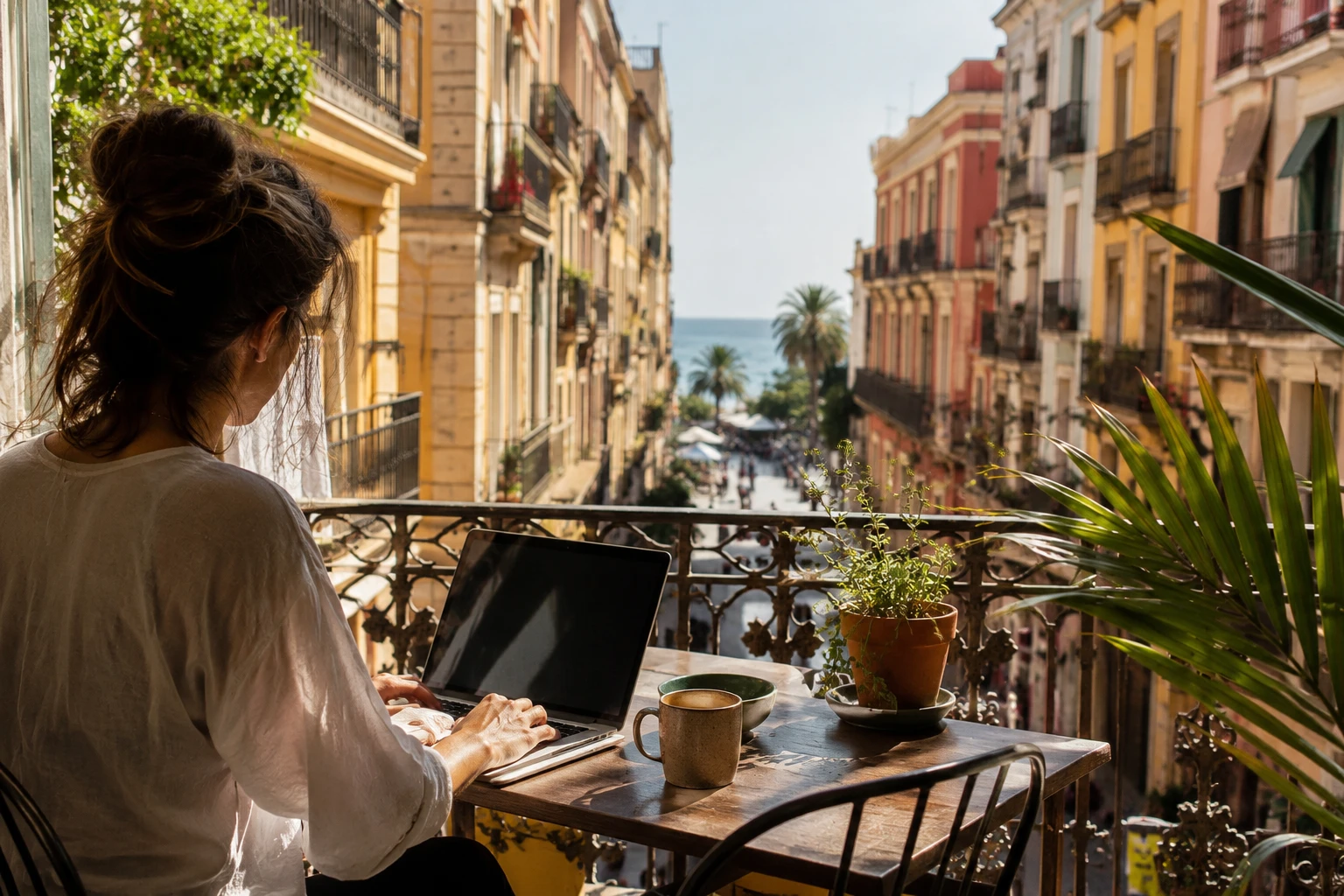
A first month coliving in Spain goes like this, give or take. Day three, you lose track of which day of the week it is. Day seven, you realise you are sleeping better than you have in two years. Day fourteen, you stop checking the temperature before going outside. Day twenty-one, you have a new best friend from a country you have never visited. Day twenty-eight, you start extending.
Coliving in Spain has quietly become one of the best decisions a remote worker can make in 2026. The infrastructure finally works. The cost is still reasonable. The food remains unbeatable. And the visa landscape has just shifted in favour of digital nomads in a way that has not been true for most of the last twenty years.
Here is the practical guide, written from inside it. What to sort before you go, where to base yourself, what a month actually costs, the rhythm you will fall into, and the five or six rookie mistakes you can quietly skip.
What to sort before you land
Most of the hassle around coliving in Spain sits in the first two weeks, and most of that can be pre-empted if you do a bit of homework before boarding.
The digital nomad visa (DNV), if you need it. Spain's DNV launched in 2023 and is now the preferred route for non-EU remote workers who want to stay longer than 90 days. It covers stays up to 5 years, includes family members, and unlocks access to a reduced flat IRPF rate for qualifying applicants under the special Beckham regime. If you are an EU or EEA national, skip all of this: you can move to Spain without paperwork. If you are British, post-Brexit you are in the non-EU bucket, so the DNV is your friend.
Banking. A Spanish IBAN is useful for direct debits on longer stays. Revolut, Wise, and N26 handle your first month while you figure out whether you need a local bank. If you do, BBVA and Santander have reasonable English-speaking digital options.
Health insurance. A Spanish residency application requires proof of coverage, but even for shorter stays, insurance matters. SafetyWing, Genki, and IATI are the common choices among nomads. Make sure the policy covers Spain specifically and not just a generic "Schengen" bundle.
Phone. Get a Spanish SIM in the first week. Yoigo, Digi, and Simyo offer 20+ GB plans for under 10 euros a month. WhatsApp is how everyone communicates here, so a local number is useful even if you are keeping your home line active.
One more: your laptop charger. Spain uses the Type F European plug. If you are coming from the UK, US, or Switzerland, bring two adapters. You will lose one.
Picking your base
Spain is a bigger country than most first-time visitors expect. "Coliving in Spain" is not one place, it is half a dozen very different places, each with its own weather, tempo, and community texture.
Big cities. Madrid and Barcelona are where the global coliving scene is loudest. Good if you want endless cafés, nightlife, and a density of other remote workers. Harder on rent, noise, and deep focus.
Mediterranean coast. Valencia, Málaga, Alicante. Warmer winters, beach access, strong digital-nomad scenes. A lot of people land here after a summer in Barcelona and never leave.
Rural Catalonia. Montseny, the Empordà, the pre-Pyrenees. An hour from Barcelona and Girona but entirely out of the urban noise. Four clear seasons, excellent food, natural parks at the door. This is our home.
Galicia. Atlantic, rainy, green, culturally distinct. Less crowded. Best for writers, introverts, and people who find heat existentially inconvenient.
Andalusia. Seville, Granada, Las Alpujarras. Hot summers, mild winters, whitewashed villages, olive groves forever. The south has the slowest tempo Spain offers.
Canary Islands. Tenerife, La Palma, Gran Canaria. Volcanic, subtropical, year-round around 20 degrees, a growing coliving scene, and a distinct tax regime worth knowing about if you are freelance.
You can try more than one. A month in Barcelona, a month in a rural coliving, a month in the Canaries is a common pattern and shifts your visa or tax calculations only slightly.
What a month actually costs
Real numbers, averaged across recent guests and updated for 2026.
- Rural coliving (Catalonia, Extremadura, Galicia): 900 to 1,500 euros per month, all-in (room, utilities, coworking, communal areas, sometimes a few weekly dinners)
- Coastal coliving (Valencia, Málaga): 1,200 to 1,800 euros per month, similar inclusions
- Big-city coliving (Barcelona, Madrid): 1,400 to 2,200 euros per month
- Food and shared groceries beyond communal meals: 250 to 400 euros per month
- Transport: 50 to 150 euros per month depending on whether you rent a car
- Flights, trips, fun: wildly variable, but budget at least 200 euros for weekends, day trips, and the inevitable spontaneous weekend in another city
Ballpark total for a modest but real first month: 1,500 to 2,500 euros. Compare that to Lisbon (up roughly 30 percent in the last two years), Amsterdam (more than double), or London (do not ask).
The rhythm most colivers fall into
By week two, the shape of a typical week emerges, and it is beautifully boring in the best possible sense.
- Monday to Thursday: deep work. Coworking space, long focus blocks, a shared lunch, maybe a short walk after
- Friday: switch-up day. Café work in a nearby town or city. Vermouth around 1pm becomes normal. Do not fight this
- Weekend: nature or culture. Hike, swim, eat, visit the next town over, sit by a fire in winter. At a good coliving, at least one of these is a group activity you can opt into
- Thursday evening: communal dinner. This is the social anchor of the week. Do not skip it in your first month
- One random day per week: you will be assigned or volunteer to cook. Take it seriously. This is how the community learns who you are
The people who thrive at coliving in Spain are the ones who lean into this rhythm rather than trying to recreate their home-country work schedule. The point is the change, not the replication.
When to come
Spain is usable year-round, but not every month is equal.
- April to June (peak magic): warm, green, sea still a touch cold for swimming in early spring, everything is in bloom. Very few tourists until late June
- September to October (the second peak): still warm, post-summer quiet, sea at its warmest of the year, colivings typically have dates open
- November to March (underrated): mild across most of Spain, rainy in Galicia and the north, snowy in the Pyrenees, but cheap and quiet. A rural coliving with a fireplace in January is genuinely magic
- July and August (book early): peak summer. Coastal colivings fill up months in advance. Rural spaces cope with the heat better but also fill. If you are coming in high season, commit early
What to pack
Keep it light. Spain is easy to buy things in once you are here, and most colivings have shared laundry.
- Swimwear (yes, even in January if you are near the sea or a hot spring)
- Layers. Spain has genuine temperature swings between morning and afternoon, especially in rural areas and at altitude
- Trail shoes. Even if you are a beach person. You will end up on a trail
- A proper power adapter, times two
- Whatever small ritual objects anchor you (journal, coffee kit, a book that reminds you why you do this). Comfort objects matter more on longer stays
- Nothing formal. Spain is warmer than you expect about dress codes
The five rookie mistakes1. Booking too short. A weekend or a week is a visit. Coliving works on the month timescale or longer. Budget accordingly, or accept that you are taking a holiday with Wi-Fi.
Staying in the city on work weeks. If your goal is deep work, pick rural or coastal. If your goal is nightlife and meetups, pick a city. Do not accidentally do both. That is the most expensive possible version of a coliving month.
Trying to keep your home-country schedule. Spain eats late, sleeps late, naps, and has long lunches. Fighting this rhythm for a month will make you tired and no fun. Lean in instead.
Skipping the communal dinners. The community's social centre of gravity is the dinner table. Miss two in a row in your first week and you will feel it in the rest of the month.
Not learning any Spanish. Even twenty words makes you vastly more welcome. Gracias, por favor, una caña, otra caña, la cuenta, perdón, no entiendo, un momento. That is half the working vocabulary you need.
What we do at Wonder House
For context, since this is where the guide is written from. Wonder House sits inside the Montseny Natural Park, an hour up from Barcelona and forty minutes from Girona. 14th century rural masia, over 800 m² of indoor space, fibre internet at 100 Mbps, a 24/7 coworking zone, nine rooms, up to 22 beds, a natural pool, a wild garden, a gym, a cinema room, two kitchens, a fireplace, themed communal dinners Monday to Friday, and a community of 8 to 22 amazing humans at any time. One-month minimum stay. Adults only.
If you want to go deeper into this specific format, our dedicated piece on rural coliving in Spain gets into the weeds. If Barcelona is your orbit, the coliving near Barcelona guide is the more useful read. If Girona is pulling harder, we have that guide too.
If your Spanish-coliving month is better spent in Valencia, Granada, or the Canaries, go there first, come find us on the second month. Either is a good decision.
Frequently asked questions
Do I need to speak Spanish for coliving in Spain?
No. Most quality colivings run in English as the shared community language. Spanish will make your life richer and the effort is appreciated everywhere, but it is not a requirement.
Is one month really the minimum? Can I come for a week?
At most serious colivings, the minimum is a month because the community dynamic collapses below that. You can find weekend-friendly places, but they are effectively serviced apartments with a coworking table. Genuine coliving needs the month.
Is Spain's internet actually good enough?
Yes, and this is one of the quieter success stories of the last decade. Spain has some of the best fibre coverage in Europe, including in rural areas, thanks to sustained national and EU investment. Expect 100 Mbps minimum at any serious coliving.
What happens with taxes if I stay longer than six months?
You become a Spanish tax resident after 183 days in the country. The DNV includes access to the special Beckham regime (a reduced flat IRPF rate for qualifying non-EU nationals, for up to 5 years). Tax rules change, so speak to a local gestor (accountant) before you cross the 183-day line. Most nomad-focused gestorías advertise in English.
Can I come as a couple?
Yes. Most good colivings have private rooms and welcome couples.
Is it safe?
Spain ranks as one of the safer countries in Europe by most metrics. Petty theft in cities (Barcelona and Madrid especially) exists and is the usual tourist-targeting pickpocket story. Rural Spain is extraordinarily safe.
Are pets welcome?
Varies by coliving. Rural houses are slightly more likely to say yes than urban ones. Always check in advance. At Wonder House specifically, we do not currently host pets (explained in our main FAQ).
Can I work on EU clients with the digital nomad visa?
The DNV is designed for remote work for employers or clients outside Spain. If you start taking on substantial Spanish clients you may trigger a different set of rules and paperwork. Speak to a gestor early if this is your situation.
Come try a month
If this guide has been useful and you are looking for a rural coliving base in Catalonia, have a look at rooms and dates on the homepage, or ping us on WhatsApp if you would rather just ask a human.
If Spain's other regions are calling louder, go there first. Come find us on the second month. Either is a good decision.
The best piece of advice anyone can give you about coliving in Spain is to actually book it. The rest is paperwork and packing.