Rural Coliving in Spain: The Real Thing, Not the Instagram Version
April 24, 2026
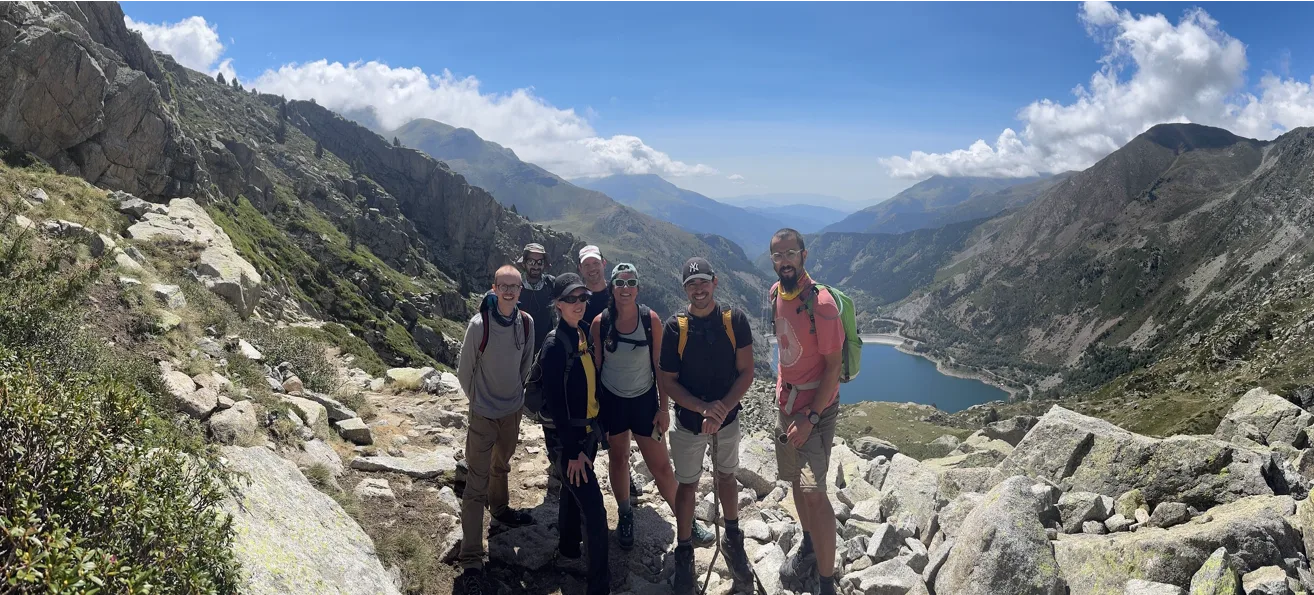
You can tell, within about thirty seconds, whether a so-called rural coliving is actually rural.
If the pictures feature thirty-year-olds in cashmere ponchos holding ceramic mugs while gazing meaningfully into middle distance, it is probably not rural. It is probably a small boutique hotel with a coworking table and a mood board. Rural is different. Rural is a building that has been standing since before the Spanish Armada, a kitchen with mismatched plates and three people making tortilla at once, a Wi-Fi router older than the average house cat but somehow still faster than most London offices, and a hiking trail that starts at the front door and ends at a waterfall nobody thought to put on a map.
This article is about that second kind. It is written from inside a 14th century masia, deep in the Montseny Natural Park in Catalonia, where Wonder House has been running rural coliving in Spain for the slow-building community of people who figured out early that focus is easier when you can actually hear the wind.
If you are searching for rural coliving in Spain, here is the useful version.
Why rural beats urban for remote work in Spain
Spain's cities are having a moment. Barcelona, Madrid, Málaga, Seville: every one of them is loaded with cafés, coworking spaces, digital-nomad meetups, and a Telegram group called something like Seville Founders Unite with 3,400 members. It is great. And exhausting. And expensive. And noisy. And after six weeks, your deep-work habit has quietly packed a bag and moved to Lisbon without telling you.
Rural Spain runs at a different tempo. A few concrete numbers worth knowing:
- Cost of living drops by 40 to 60 percent versus central Barcelona or Madrid. A full month in a rural coliving can cost what a single week in a central-city short-term rental would
- Ambient noise drops to near zero. Genuinely. The loudest thing outside your window at 3am is a distant owl having a deep conversation with another owl
- Nature is at the door. Spain has 16 national parks and more than 150 natural parks, covering roughly 15 percent of the country. Most of them do not appear on any coliving aggregator, because the people running things there are busy, well, running things
- Deep work becomes default. Eight-hour writing and coding days stop being a bargain with your environment and start being what the day already looks like
- Community is tighter. When there are 8 to 22 of you in a village-scale house, you know everyone's name by day three and everyone's coffee order by day five
There is a reason Spanish writers, painters, and musicians have been fleeing to the countryside for centuries. Deep work wants space. Space lives out here.
What actually makes a rural coliving good
Before we talk specifics, here is the honest filter that separates the real thing from the Instagram version. Bring it to anything you research next, including us.
The internet has to be serious. Fibre, minimum. 100 Mbps down or more. Backup connection a plus. "Decent Wi-Fi" is a red flag. Stable video calls on a hillside are not a flex, they are a baseline requirement for a functioning remote life.
There has to be a dedicated workspace. Not the kitchen table. Not a "flexible corner." A real coworking room, ergonomic chairs, monitor arms or laptop stands available, and it has to be open 24/7 because your team is in seven time zones and you know it.
The minimum stay has to be long enough to matter. One month minimum is the honest bar. Weekend visitors ruin rhythm. Communities form around people who stay.
The community has to be real. Not strangers passing in a hallway. Communal dinners, shared spaces, optional-but-real activities. A house with 12 people ignoring each other is just a hostel with a coworking sign taped to the door.
Nature has to be genuinely present. Walking distance to a forest, a river, a mountain, a beach. Not photographed. Actually there. Not "a short drive away." At the door.
The place should have opinions. A rural coliving with a generic "all are welcome" brochure is a brochure. A rural coliving that says "this is who it is for, this is how we do things, this is what we love" is a community.
That is the short list. Apply it generously.
Wonder House: the rural coliving in Spain we actually run
This is where the self-promoting bit lands. We are going to be direct about it. Other established colivings in Spain do the same on their own blogs. It is a reasonable thing to do, and frankly, if you are researching rural coliving in Spain, you probably want someone to just tell you clearly what they offer and let you decide.
Wonder House sits inside the Montseny Natural Park, a UNESCO Biosphere Reserve of oak forest, chestnut trees, and hiking trails, 60 minutes up the AP-7 from central Barcelona and 40 minutes from Girona. The house itself is a 14th century rural masia with over 800 m² of indoor space, wrapped in forest, with the kind of quiet that has nothing to prove.
What is inside:
- 9 rooms, up to 22 beds. Private and shared. Couples welcome. We usually keep the house deliberately less than full
- A dedicated 24/7 coworking zone with ergonomic chairs, fibre internet at 100 Mbps down and 10 to 20 up, and coverage that extends into the garden
- Two kitchens, a living room with a fireplace, a cinema room, a gym, two barbecue areas, a natural pool, a wild garden, and a forbidden room we all pretend doesn't exist
- Themed communal dinners Monday to Friday (small extra fee), cooked by a rotating crew of amazing humans, you included, once a week
- A community of 8 to 22 people at any time: remote workers, founders, writers, designers, the occasional pro cyclist in Girona for a training block
- Minimum stay: one month. Because real connection does not happen in a weekend
The rhythm most colivers settle into: four heads-down work days in the masia, a café day in Girona or Barcelona for a change of scenery, weekends on the Costa Brava or up in the Pyrenees. Weekly hikes, shared dinners, yoga, the occasional wildly over-ambitious themed party. Skip everything. Show up for everything. Both are fine.
We are adults-only, we are honest about that on the homepage, and the filter works.
Where rural coliving actually happens in Spain
"Rural coliving Spain" covers a surprisingly big map. Useful to know the geography if you are shopping around the whole country.
Catalonia (our home). Montseny Natural Park, the Empordà, the pre-Pyrenees. Close to Barcelona and Girona airports. Mediterranean influence, four clear seasons, great food, strong digital infrastructure. This is where we live.
Galicia. Rainy, lush, Atlantic, green the way Ireland is green. Slow food, strong local culture, great for writers who actually want to write and not be distracted by sunshine.
Andalusia. Sierra Nevada, Las Alpujarras, inland Cádiz. Hotter, drier, whitewashed villages, olive groves as far as you can walk. Good for long-season colivers who do not mind summer heat.
Extremadura and inland Castile. Dehesas (oak pasture where acorn-fed pigs wander), black vultures, almost no tourists. The quietest rural Spain has to offer. Rural broadband has improved dramatically here in the last five years thanks to European connectivity grants.
Canary Islands. Volcanic, subtropical, with Tenerife and La Palma seeing the most coliving activity. Different cultural feel, and a distinctive tax regime worth knowing about if you are freelance or running a small company.
Every region makes a case. We like ours because it hands you Montseny's forest, the Mediterranean 30 minutes away, Barcelona one hour away, the Pyrenees 90 minutes away, and Girona airport with its direct Ryanair links to half of Europe. Few other rural regions in Spain combine that many doors out of one front door.
Getting to rural Spain (and specifically, to us)
- By plane. Barcelona El Prat is a one-hour drive and has direct connections to basically every European hub plus North and South America. Girona Costa Brava is a thirty-minute drive and is Ryanair's main base. Both are realistic airports for a monthly client trip or a weekend escape
- By train. Hostalric station is the closest to the house. Direct Rodalies trains from Barcelona Sants and Passeig de Gràcia, around an hour. We can pick you up from the station
- By car. AP-7 up from Barcelona. Parking on site. About an hour
- From elsewhere in Spain. High-speed AVE trains connect Barcelona to Madrid in 2h30, Seville in 5h30, Málaga in 5h45, Zaragoza in 1h30. Once you are at Sants, you are one hour from the front door
Who this actually works for
You will fit if you are:
- A remote worker who has quietly realised that city life and deep work pull in opposite directions
- A founder or operator between things, needing space to think and a small tribe
- A writer, designer, or researcher working on something that deserves a month of real quiet
- A remote team planning a one or two week offsite (we host these often)
- Someone recovering from a life transition (a degree, a relationship, a job, a city) wanting a soft reset
- A digital nomad who has already done Lisbon, Mexico City, Medellín, and is quietly looking for the slower Catalan version
You probably will not love it if you need bars open until 4am, a new restaurant every night, or twelve coworking venues to hop between. That is Barcelona. We are an hour from there.
Frequently asked questions
What does rural coliving actually mean?
A coliving space in the countryside rather than a city. Rural as opposed to urban. In our case, that is a 14th century masia inside a UNESCO Biosphere Reserve, one hour from the nearest big city. Village-scale community, natural surroundings, slow rhythms, and still-serious infrastructure (fibre internet, dedicated coworking space, stocked kitchens).
How is rural coliving different from regular coliving?
Pace and silence, mostly. Urban colivings are brilliant, but they compete with the city for your attention every hour. Rural colivings do not. Your environment stays quiet, the community dynamic tightens (you cannot just vanish into a metro), and deep work becomes the default rather than an uphill climb.
Is the Wi-Fi actually fast enough?
Yes, genuinely. 100 Mbps down, 10 to 20 up, fibre, with coverage extending into the garden. Video calls are reliable. Large uploads do not sigh. Spanish rural broadband has quietly become excellent in the last five years, in large part thanks to EU rural connectivity funding.
How long do people usually stay?
Minimum is one month because real community takes at least that long. The typical stay is around six weeks. A healthy number of guests extend twice.
Can I come as a couple?
Yes, private rooms are available and couples slot into the community normally. We host everyone from solo travellers to remote teams on offsite.
Is it year-round?
We are open year-round. The most magical windows are April to June (warm, green, uncrowded) and September to October (still warm, post-summer quiet). Summer is busy and gorgeous. Winter is underrated: quiet, sunny most days, and the fireplace earns its keep.
Do I need Spanish or Catalan?
You do not. Our community runs in English as the common language. Spanish and Catalan help if you want to get deeper into village life, which some colivers do, and locals are patient with the attempts.
Do I need a car?
Useful but not required. Hostalric station is a short drive, ride-sharing between colivers is routine, and we run shared trips into town and to the coast. Plenty of guests arrive carless and do fine.
Come see for yourself
The honest pitch: if rural coliving in Spain is what you have been quietly looking for, come do a month. Shoulder season ideally. Work from the masia four days, run into Girona or Barcelona for one, spend the weekend in the forest or on the Costa Brava, and notice what happens to your sleep, your focus, and what you actually finish.
Rooms and dates are on the homepage, or ping us on WhatsApp if you would rather just ask a human. We reply quickly. Unless we are in the hammock. Which happens.