Spain Digital Nomad Visa for Americans: The Plain-English Version
May 8, 2026
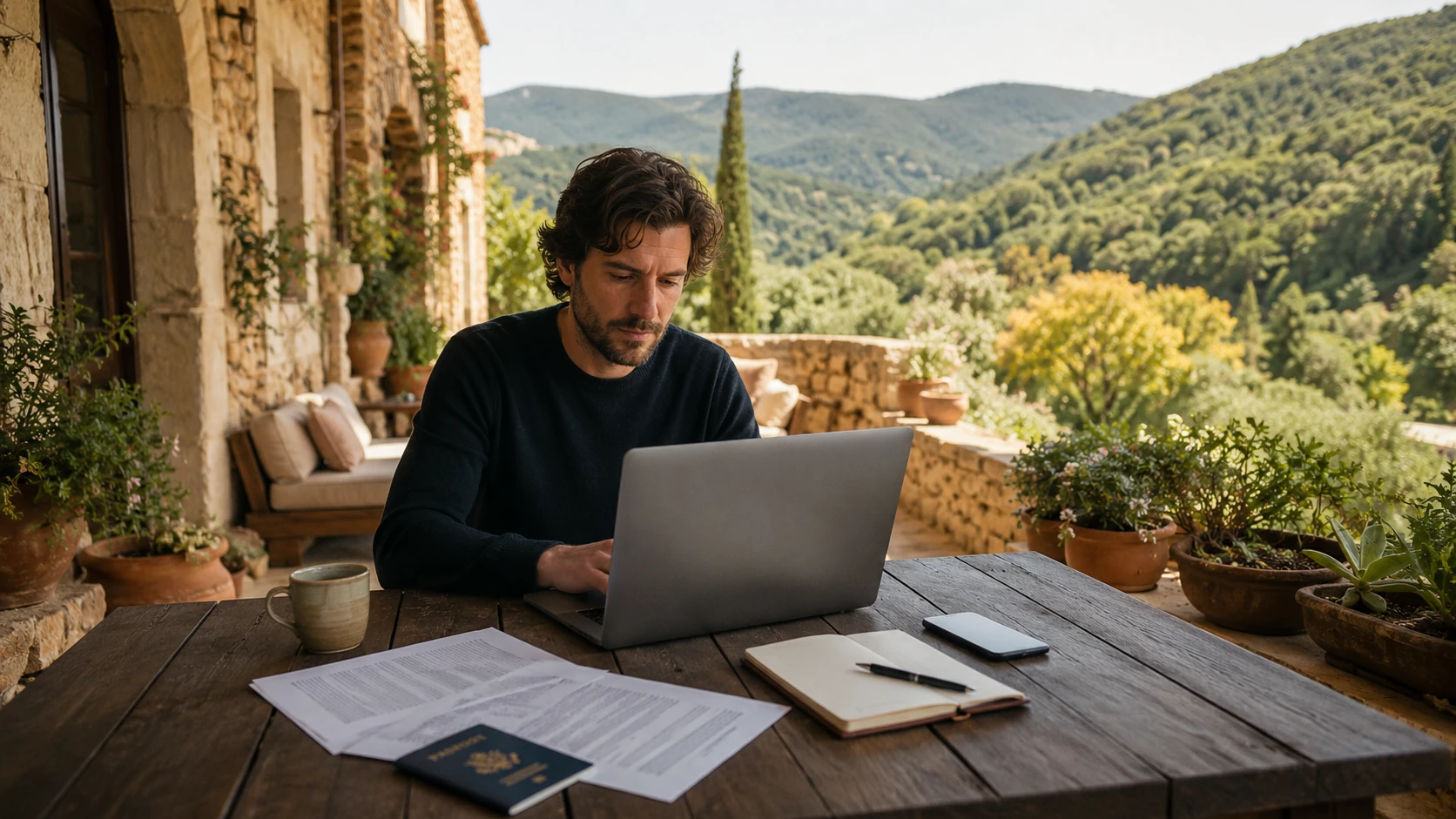
So you are sitting in a US city paying $3,200 a month for a one-bedroom, watching daylight savings shave half an hour off your evenings, and wondering whether the people in your team's Slack who keep posting from places like Sevilla and Las Palmas know something you do not.
They do, mostly. Spain quietly opened a digital nomad visa in early 2023, it has now been running long enough that the kinks are largely ironed out, and for the first time in a generation, an American remote worker can legally live and work from Spain for up to five years without doing paperwork acrobatics. This article is the plain-English version of how that actually works, written from inside a coliving in the Catalan countryside where Americans turn up every few weeks to figure it out in person.
This is not legal advice. Visa rules change, sometimes quickly, and your specific situation matters. Use this to get oriented, then talk to an immigration lawyer before you actually file. Names of good ones at the bottom.
What the Spain digital nomad visa actually is
Spain's digital nomad visa DNV launched in January 2023 as part of the Ley de Startups Startup Act. The short version: if you are a non-EU remote worker earning income from outside Spain, you can apply for a one-year visa that converts into a three-year residency permit, renewable for two more years. After five years of legal residency, you become eligible for permanent residency in Spain. After ten years, citizenship is on the table for those who qualify.
For an American, this is the cleanest legal route to live in Spain longer than 90 days without marrying a Spaniard, getting a job at a Spanish company, or pretending to study. It is the route most US remote workers we host at Wonder House have used.
A few things the DNV is not:
- It is not a tourist visa. The Schengen 90 in 180 rule is the tourist route. The DNV is residency
- It is not the Non-Lucrative Visa. That older visa specifically forbids working, even remotely. The DNV permits remote work and is the visa Americans actually want
- It is not a startup visa. There is a separate entrepreneur track in the same Startup Act. The DNV is for people on payroll or running solo client work, not founders raising capital
Are you eligible? The five honest filters
Run yourself through these before you do anything else.
1. Your income comes from outside Spain
You can work for a US employer remotely. You can run a US-based freelance practice with US clients. You can be a contractor for a non-Spanish company. You cannot draw the bulk of your income from Spanish clients, although a small fraction is allowed, currently capped at 20 percent of total.
2. Your role is remote-compatible by nature
Spain wants evidence your job can actually be done remotely. Software engineer, designer, content writer, marketer, consultant, researcher, online tutor: easy. Anything that involves an in-person Spanish workplace: not the right visa.
3. Your income clears the threshold
As of 2026, the bar is 200 percent of Spain's monthly minimum wage, which works out to around 2,646 EUR per month, or roughly 31,750 EUR per year. For a partner you bring along, add 75 percent of the minimum wage. For each child, another 25 percent. American salaries usually clear this comfortably, but freelancers should be ready to show consistent income across the last three to six months, not a single big invoice.
4. You have a clean record
Spain runs a background check. A criminal record from the last five years is a problem. Apostilled FBI background check is part of the application packet.
5. You have a degree or three years of experience in your field
A bachelor's degree from an accredited US university, apostilled and translated, satisfies this. So does documented work history. Both are fine.
If you tick all five, the DNV is a real option for you.
Apply from the US, or apply from Spain?
This is the choice most Americans get stuck on.
From the US
You apply at the Spanish Consulate that covers your state. Washington DC, Boston, Chicago, Houston, Los Angeles, Miami, New York, San Francisco, San Juan. The visa is issued for one year, and you fly to Spain with that visa already in your passport. Once in Spain, you trade it for a three-year residency card. This is the cleaner route on paper. It is also slower, since consulate appointments can be two to four months out depending on the city, and you pay for a notary appointment, an apostille, and certified Spanish translations of every document while sitting in the US.
From Spain
You enter as a tourist, 90 days visa-free for Americans, and you apply in country through the UGE Unidad de Grandes Empresas, the same office that handles Startup Act applications. This route runs faster, often resolved within 20 working days. It is also less stressful in the sense that you can do an apartment scout, a coliving stint, a tax appointment, all in person while the application is processing. The catch: you must apply before your tourist 90 days run out, and if you get denied, rare, but it happens, you have to leave Schengen and reset.
A meaningful number of US remote workers we host at Wonder House do the second route, exactly because doing it in person, with a stable Spanish address and good Wi-Fi, removes most of the friction. Some come for a month at the masia, file the application from here, and stay on through processing. The address is real, the Wi-Fi is real, and the country is no longer abstract by the time the residency card arrives.
If you have the time and the budget, in-Spain is faster and saner. If you need certainty before flying, US-side is cleaner. Both are valid.
What you actually have to gather
The list is long but not mysterious. Treat it as a project, not a panic.
- Valid US passport with at least one year remaining
- FBI background check, apostilled, translated to Spanish
- Proof of income for the last three months: employment contract, recent paystubs, or freelance invoices and bank statements
- Letter from your employer authorising remote work from Spain, or, for freelancers, evidence of business activity and client list
- Proof of degree or three-plus years of relevant work experience, apostilled and translated
- Private health insurance from a provider authorised in Spain: Sanitas, Adeslas, DKV, Cigna Spain, Allianz Care all qualify; SafetyWing nomad-tier sometimes does not
- Proof of address in Spain: rental contract, owner's letter, or in some cases a coliving stay agreement on letterhead
- Application fee, currently around 73 EUR, paid via Modelo 790
- Form EX-00 national visa or EX-04 residency, in-Spain track
- Modelo 790 código 052 fee receipt
The address proof is the one Americans most often underestimate. Spanish bureaucracy wants a real, verifiable address. A hotel booking does not work. A long-stay coliving stay agreement on company letterhead does. So does a lease.
Taxes, in plain English
Here is where you really do need a cross-border accountant. Skip our summary, file with a professional. But the shape of it:
The US and Spain have a tax treaty. It is from 1990, updated in 2019. It exists specifically to avoid double-taxation. It works.
You will likely become a Spanish tax resident if you stay more than 183 days in any calendar year. Resident in Spain means worldwide income gets reported to Spain.
The Beckham Law régimen especial is a real option. Named after the football player, it lets qualifying expat workers pay a flat 24 percent on Spanish-source income, up to 600,000 EUR, plus a flat rate on capital gains, for the first six tax years. Originally designed for footballers and executives, the 2023 Startup Act explicitly extended it to digital nomad visa holders. If you qualify, the math often works in your favour vs standard Spanish progressive rates.
You still file a US tax return. Americans abroad do, always. The Foreign Earned Income Exclusion FEIE lets you exclude up to roughly 130,000 USD of foreign-earned income, 2026 figure, from US federal taxes. Foreign Tax Credits handle the rest if you owe more in Spain. State taxes vary: California and New York are sticky, Texas and Florida are not.
FBAR and FATCA. If you open Spanish bank accounts and they hold more than 10,000 USD at any point, FBAR. Over 50,000 USD, FATCA Form 8938. Yes, even just for living here. No, it is not a big deal if you file on time.
The total tax outcome depends entirely on your income shape, your Beckham eligibility, and your home state. For most US salaried remote workers under 200,000 USD, total tax exposure under DNV + Beckham ends up similar to or slightly better than what you were paying back home, with worse weather. For higher earners, the math gets nuanced. Get the accountant.
Where coliving fits in
Two practical reasons coliving works well as the first move for an American on the DNV path.
1. Address proof, the painless way
Most of our American guests use their stay agreement at Wonder House, or the equivalent at any reputable coliving, as proof of address for the application. The agreement is on letterhead, signed, with a real Spanish street address. UGE accepts it for the in-Spain track. Consulates have been more variable about it, so confirm with yours, but several of ours have used it successfully for the US-side application too.
2. The first month is the orientation problem solver
Spanish bureaucracy is not actually hostile, it is unfamiliar. NIE appointments, social security registration, opening a Spanish bank account, sorting health insurance, finding a real long-term apartment: all of it is easier with a community of people who did the same paperwork three months ago. At any given time, our coliving has someone who recently filed every form on your list. Asking the human in the kitchen at 9pm is faster than reading another forum thread.
A typical American DNV path through Wonder House looks like: arrive end of month one, settle in, file the application during week two or three, do an NIE appointment in Girona, get a Spanish phone Yoigo SIM, eight euros, open a Wise EUR account or apply for BBVA, scout long-term apartments in Barcelona/Girona/Madrid on weekends, extend your stay at the coliving while paperwork processes, and either move out into your own apartment after 60 to 90 days, or extend further because you realised you actually like it here.
We are honest about that last bit. About a third of our American guests cancel their apartment hunt and just stay.
Frequently asked questions
Is the Spain digital nomad visa actually open to Americans?
Yes. The visa is open to any non-EU/EEA national who meets the eligibility criteria. Americans, Brits, Canadians, Australians, and most Latin American nationalities are common applicants. There is no per-country quota.
How long does the Spain DNV take to process?
From Spain, in-country through UGE, 20 working days is the legal target, often hit. From the US consulate, 30 to 60 working days plus appointment lead time. Plan for three months total in either case if you are stacking apostilles, translations, and consulate appointments.
Does the Spain digital nomad visa cover my spouse and kids?
Yes, the DNV is designed to include family. Add 75 percent of the minimum wage to your income threshold for a spouse, 25 percent for each child. Apply for theirs at the same time as yours.
Can Americans use a coliving address for the Spain digital nomad visa application?
Often yes. A long-stay coliving, one month minimum, ideally three or more, typically qualifies as proof of address for the in-Spain UGE track. Consulates abroad are more variable. Confirm with your specific consulate before relying on it.
What is the income requirement for the Spain DNV in 2026?
Around 2,646 EUR per month, 200 percent of the Spanish minimum wage, or roughly 31,750 EUR per year. Higher for applicants bringing dependents. Verify the exact figure on the Ministry of Foreign Affairs site, since the minimum wage updates each year.
How are American taxes handled if I live in Spain on a DNV?
You file in both countries, the US/Spain tax treaty prevents double-taxation, and the Beckham Law régimen especial is available to many DNV holders for a flat 24 percent rate on Spanish-source income for six years. Get a cross-border accountant. Do not freelance this part.
Can I apply for the Spain DNV from the US?
Yes, through the Spanish consulate that covers your state. Appointments can be two to four months out, so book early. The alternative is to enter Spain as a tourist and apply in-country, which is faster.
What to do next
If you are seriously researching, the practical next steps are:
- Confirm you tick the five eligibility filters above
- Decide US-side application or in-Spain application
- Book an immigration lawyer consultation, one hour, around 200 to 400 EUR, almost always worth it
- Book a cross-border tax consultation, separate from the lawyer
- If going the in-Spain route, book a one-month coliving stay to anchor your address and your sanity
We host that last bit at Wonder House, in a 14th century rural masia in the Montseny Natural Park, an hour from Barcelona. Fibre internet, dedicated 24/7 coworking, a community of remote workers from a dozen countries, Americans regularly among them, and someone in the kitchen who recently filed every form on the list. Rooms and dates are on the homepage. WhatsApp is the fastest way to ask a human anything.
Spain is not perfect. The bureaucracy is slow, the August heat is real, and you will get a parking ticket within your first month no matter how careful you are. It is also one of the best places on Earth to do remote work in 2026, and the visa is finally there.