Coliving Costa Brava: A Remote Worker's Guide to the Coast
July 6, 2026
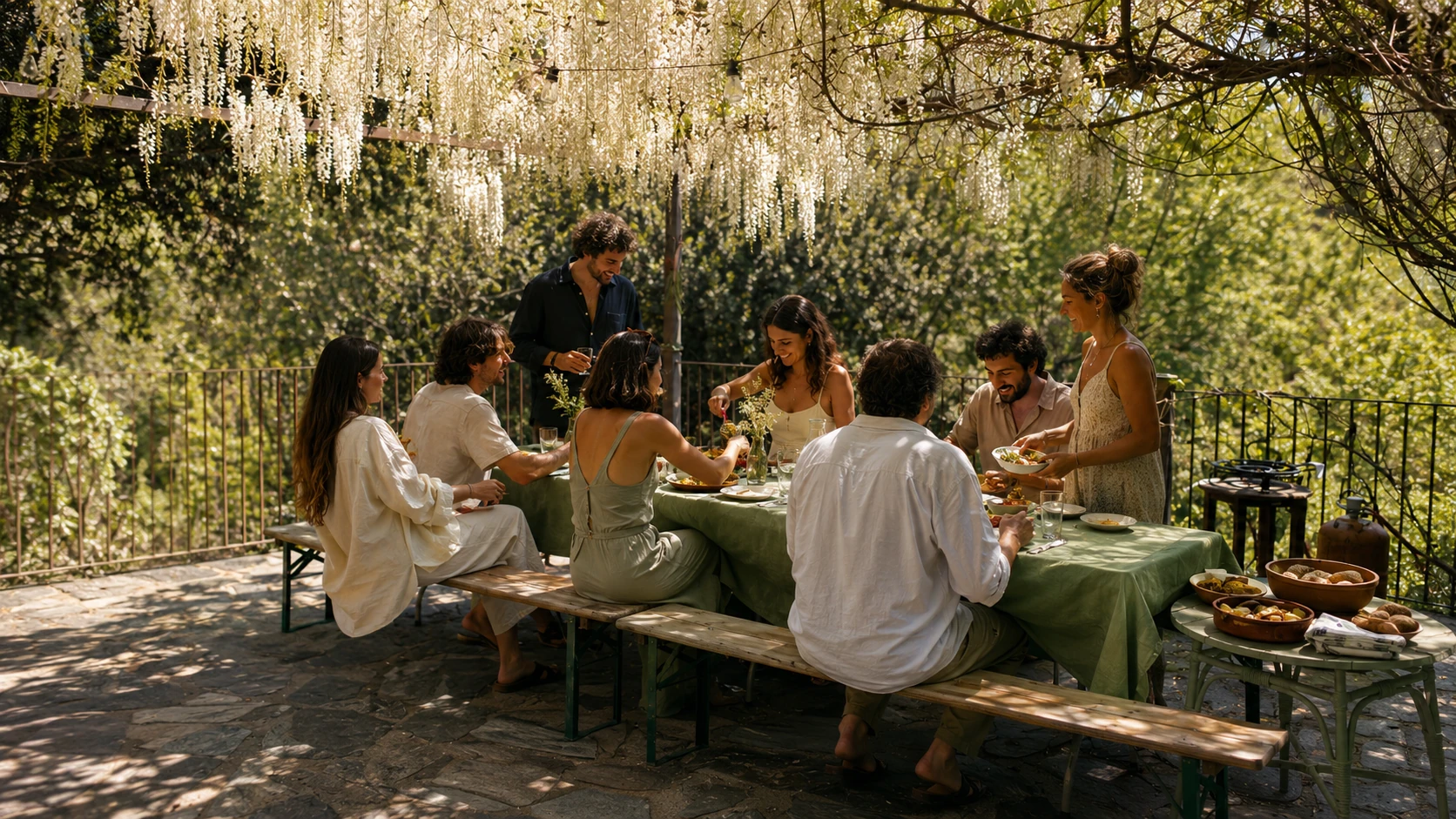
Coliving Costa Brava: The Offbeat Guide to Catalonia's Coast
Everyone pictures the same thing when you say Costa Brava. Sunburnt package tourists, a sangria bucket, a beach you can't see the sand of. That Costa Brava exists. It's a thin strip of it, in July, in two or three towns, and you can drive right past it.
The other Costa Brava is the one a small, smart bunch of remote workers is quietly building a life around. Hidden coves you reach on foot. Medieval fishing villages with one good bakery and no traffic. Pine cliffs dropping straight into water so clear it looks edited. Some of the best food on the planet, ten minutes from where you slept. And fibre internet running into stone houses built before the printing press.
If you're looking for coliving Costa Brava style, the real kind with a community, a proper desk, and weekends that involve zero Zoom backgrounds, here's the thing nobody tells you: the sweet spot isn't on the beach. It's an hour inland, in the Montseny forest, where Wonder House has quietly been doing this for a while. The coast is your weekend. The forest is your base. Let us explain why that's the right way round.
Why the Costa Brava, and why not actually on it
The Costa Brava runs about 200 kilometres up the northeast corner of Catalonia, from Blanes to the French border, all of it in the province of Girona. "Brava" means wild, and they named it that for a reason. This is not the flat, built-out Costa del Sol. It's coves, cliffs, umbrella pines, and a coastal footpath (the Camí de Ronda) that stitches the whole thing together so you can walk from beach to beach with your shoes in your hand.
So why would a coliving sit an hour back from all that?
Because living on a tourist coast is a trap. The good coastal towns (Cadaqués, Begur, Calella de Palafrugell) are gorgeous and half-empty for eight months of the year, then triple in price and population for two. Rentals are short-term, seasonal, and built for holidaymakers, not for someone who needs the same fast desk every Tuesday in February. You'd spend your life either overpaying in peak season or sitting in a shuttered town in the off-season wondering where everyone went.
A base in the Montseny solves both. You get the coast whenever you want it, just over an hour away, and you come home to a four-season community that doesn't pack up and leave in September. Best of both, minus the sunburn negotiation.
Practical stuff while we're here:
- Wonder House to the nearest Costa Brava coves: just over an hour by car
- Girona (the gateway city): about 40 minutes, and from Girona the beaches are another 30
- Girona-Costa Brava airport: roughly an hour, direct flights to most of Europe
- Barcelona El Prat: about 70 minutes if you're coming the long way
- Internet at base: 100 Mbps fibre into a 14th century masia (yes, we also find that funny)
What coliving on the Costa Brava actually looks like
Here's the honest version. Most "coliving Costa Brava" results you'll find are aggregator listings, a couple of summer villa shares, and a reddit thread of people asking the exact question you're asking. Genuine, year-round, community-first coliving with a dedicated workspace is thin on the actual coast. That's the gap.
What we run is the forest counterpart to all of it. An 800m² masia in the Montseny Natural Park, rooms for a rotating tribe of amazing humans, a real coworking room with a forest view, long communal dinners, and a hammock situation that has ended more than one productive afternoon. Then, on the days the spreadsheet can wait, you point the car at the sea.
A typical week looks less like a holiday and more like a better version of your normal one. You work mornings while the forest holds the silence. You take calls on a terrace. And on Friday, instead of the same four walls, you're swimming off a cove near Begur that you had to walk twenty minutes down a pine path to reach, because the people who drive past don't know it's there.
That's the whole pitch. Community and deep work in the week. Wild coast on the weekend. No lease, no furniture run, no figuring out Spanish utility bills.
The coast towns worth your weekends
You don't need all 200 kilometres. You need four or five places you return to. Ours, in no particular order:
Cadaqués. The whitewashed one at the far north, where Dalí lived, reachable only by a twisty mountain road that keeps the crowds honest. Worth the drive. Go for the day, stay for the light.
Begur and its calas. Begur sits on a hill; below it are a string of tiny coves (Sa Tuna, Aiguablava, Fornells) that look like someone invented them for a screensaver. This is peak Camí de Ronda walking.
Calella de Palafrugell. A working fishing village that somehow never got ruined. White arches, blue boats, a habanera festival in summer. The off-season version is even better.
Tossa de Mar. The most southern of our regulars, a walled medieval old town that runs straight down to the sand. Closest to base, good for a half-day when you can't spare a full one.
Cap de Creus. Not a town, a headland. The wildest, most lunar bit of the whole coast, a natural park where the Pyrenees finally fall into the Mediterranean. Bring water and good shoes.
You can read the full regional breakdown, coast plus mountains plus city, in our guide to coliving in Catalonia, and the inland sister piece on coliving near Girona if the medieval-city angle is more your speed.
The food thing is not a marketing line
We need a paragraph on this because people think we're exaggerating. This stretch of coast and its hinterland holds one of the highest concentrations of seriously good food in Europe. The region gave the world El Bulli (now closed, still mythologised) and currently holds more Michelin attention than feels fair for an area this small. But forget the stars. The actual day-to-day is a village restaurant doing grilled fish that was in the water that morning, a market in Palafrugell, a vermouth at noon because that's the local clock. You will eat better here, by accident, than you do on purpose at home.
Who this is for (and who it isn't)
This works if you're a remote worker, a founder between things, a designer, a writer, anyone whose job lives in a laptop and whose soul needs a coastline. It works especially well if you're tired of doing the digital-nomad thing solo and want a built-in tribe without the small talk of a hostel.
It does not work if you want to live with your toes in the sand 24/7, or if a 9pm communal dinner with strangers who become friends sounds like a nightmare rather than the point. No hard feelings. We're a specific kind of place for a specific kind of person.
If that person is you, this is one corner of the larger story we tell about rural coliving in Spain: the idea that the best base for a life by the Mediterranean might be a forest, an hour back from the water, full of people you haven't met yet.
Getting here
- Fly into Girona-Costa Brava (GRO) for the most direct route. Ryanair and others run it cheap from across Europe. We'll sort the last hour.
- Or Barcelona El Prat (BCN) if the flight times work better, then north by car or train.
- Train: RENFE Rodalies and the high-speed line both serve Girona; we bridge the final stretch into the Montseny.
- Car: useful but not essential. The coast is more fun with one, the forest is fine without one, and carpools to the beach are half the weekend ritual.
When you want the long version of how the region fits together, the coliving in Catalonia guide maps all of it, airports, trains, provinces, the lot.
Frequently asked questions
Is there real coliving directly on the Costa Brava? Very little of the year-round, community-with-a-workspace kind. The coast is built for seasonal tourism, so most options are summer villa shares or short-term holiday rentals. A base just inland, like Wonder House in the Montseny, gives you the coast on weekends and a stable four-season community the rest of the time. That's what makes coliving Costa Brava actually livable past August.
How far is Wonder House from the Costa Brava beaches? Just over an hour by car to the nearer coves around Tossa and the southern stretch, a little more to the northern showpieces like Cadaqués and Cap de Creus. Girona sits between us and the sea at about 40 minutes, and the beaches are roughly 30 minutes beyond that.
Can I actually get work done, or is it a permanent holiday? You can work. There's a dedicated coworking room with 100 Mbps fibre, forest-facing desks, and a community that respects focus hours. The coast is the reward, not the distraction. Most people are more productive here than at home, because the week has a shape and the weekend has a sea.
When is the best time to come? The shoulder seasons are the secret. May, June, September and October give you warm water, empty coves, and coast towns that still feel like real places. July and August are beautiful but busy on the sand; the upside of being inland is you choose when to deal with that.
Do I need a car? Not to live here, but it helps for the coast. Plenty of people come without one and rely on carpools and the train. Getting a group together to drive out to a cove is one of the better weekend habits the house tends to form.
Come see the wild coast from the quiet side
The Costa Brava is best enjoyed by people who don't live on it: who arrive on a Friday, know which cove to walk to, swim while the day-trippers are stuck in traffic, and drive home to a forest full of friends. That's the life we've built, an hour back from the water.
Curious? Have a look at the rooms, or just say hello and tell us when you want the sea.