Working Remotely from Spain: The Practical 2026 Guide
June 8, 2026
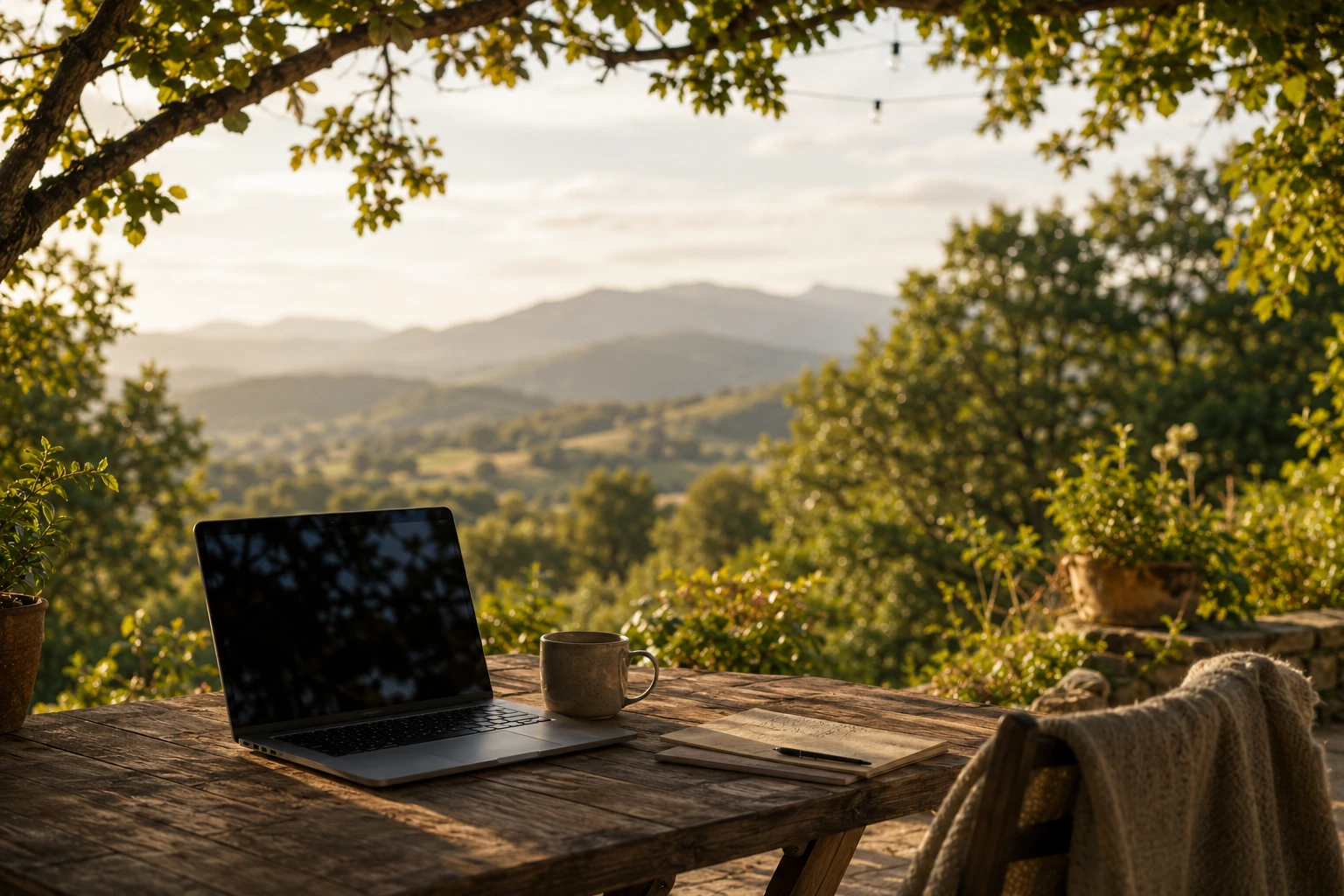
Rural Retreat Spain: The Kind You Stay a Month, Not a Weekend
Search "rural retreat Spain" and you get villas. Beautiful ones, to be fair: whitewashed Andalusian fincas, Catalan farmhouses with infinity pools, three-night escapes priced per person per night with a welcome basket and a checkout time. That is one kind of rural retreat, and if you want a long weekend of doing nothing in the countryside, the internet has you covered.
This is about the other kind. The rural retreat you do not check out of on Sunday. The kind you settle into for a month or a season, where the point is not a quick reset before returning to the life that wore you down, but a different rhythm you actually get to live inside for long enough to feel it change you. We run one of those, so this is written from the inside.
Both kinds are valid. They are just answers to different questions, and most people searching for a rural retreat in Spain have not been told the second kind exists.
The two kinds of rural retreat in Spain
The difference is length, and length changes everything.
The holiday retreat is the default. A few nights in a gorgeous rural property, often a villa or a boutique rural hotel, sometimes built around yoga or wellness or simply silence. You arrive depleted, you exhale, you eat well, you leave slightly restored, and you return to exactly the life you left. It is a pause. A good one. But a pause is, by definition, temporary, and the thing that exhausted you is still there when you get back.
The stay-and-live retreat is the one fewer people know to look for. Instead of escaping your life for three nights, you relocate it to the countryside for a month or more. You bring your work, because you can now, and you do it from a desk that looks into oak forest instead of a wall. The retreat is not a break from your life. It becomes your life, temporarily, in a better setting. And a month is long enough that the better rhythm stops feeling like a holiday and starts feeling like a question: why was I not living like this before?
The first kind resets you. The second kind can quietly rearrange you. This article is about the second kind, because the first kind is everywhere and the second kind is the one worth explaining.
Why "retreat" and "remote work" stopped being opposites
For most of history a retreat meant disconnection. Switch off, go quiet, leave the world. The whole appeal was being unreachable.
Then two things happened. Work became something a lot of us carry in a laptop, and the Spanish countryside got fibre internet. Suddenly you did not have to choose between a forest and a functioning career. You could have the silence and the video call. You could retreat from the city, the commute, the noise, the performance of being busy, without retreating from the work that pays for your life.
That is the quiet revolution behind the stay-and-live rural retreat. It is not a digital detox, although you will detox from plenty: the traffic, the small talk, the ambient stress of a city that never fully exhales. It is a digital relocation. The work comes with you. Everything else that was grinding you down does not.
At our place the internet is 100 Mbps fibre, running into a fourteenth century stone farmhouse, holding strong into the garden. You can take a call from California in the morning and walk into a natural park in the afternoon, and the only thing that changes about your work is that it gets better, because you are not doing it while quietly falling apart.
Where the good rural retreats are
Spain is large and gloriously empty in the right places. A few regions earn the search.
Andalusia owns the postcard version: white villages, olive groves, big skies, the most-photographed rural retreats in the country. Hot in summer, romantic in spring, the home of most of those villa results you found.
Galicia and the north are the green, misty, Atlantic alternative: stone houses, deep forest, cooler air, fewer crowds, a wilder feeling.
Catalonia, where we are, is the one that quietly wins for the stay-and-live version, and not by accident. You get genuine countryside, a natural park, mountains, and the coast, all within reach of Barcelona and two airports. You can retreat properly into nature and still be an hour from a great city and a short hop from a Ryanair flight home. That combination, deep rural calm plus real connection to the world, is rare, and it is exactly what makes a long retreat sustainable rather than isolating. It is the same logic behind rural coliving in Spain, which is what the stay-and-live retreat becomes when you add other people to it.
What a working rural retreat actually looks like
People imagine a month in the countryside as either a spa or a hermitage. It is neither.
Mornings start with light instead of an alarm, because the city noise that used to jolt you awake is gone. Coffee, often with someone else already in the kitchen. Deep work through the bright part of the morning, the kind of focused stretch that the office, with its meetings and interruptions, somehow never allowed. A long real lunch, the Spanish way, as the main meal of the day. Afternoons split between lighter work and the outdoors: a trail that leaves the gate, a swim, an hour with a book. Evenings that rotate between a shared dinner, an early night, and the occasional long conversation that runs past midnight because nobody has anywhere to be.
The thing that surprises people most is that they get more done, not less. The retreat does not cost you your productivity. It removes the things that were quietly destroying it.
Cost, seasons, and the practical bit
A stay-and-live rural retreat costs less than you think, because you are not paying holiday-villa nightly rates. Monthly stays in a rural coliving are a fraction of per-night retreat pricing, and they fold accommodation, workspace, fast internet, and often most meals into one number. Compared to a city flat plus a coworking pass plus eating out, the countryside frequently wins outright.
Seasons matter more in the countryside than the city. Spring and autumn are the sweet spots almost everywhere: warm enough to live outdoors, quiet, and at their most beautiful. Summer is gorgeous but hot in the south and busy everywhere. Winter is the underrated one, especially in places with a fireplace, where deep work feels easiest when the world outside has gone quiet and the social life moves indoors. There is no wrong season for a rural retreat in Spain, only different versions of the same place.
The one practical rule: confirm the internet before you commit if you intend to work. A genuine stay-and-live retreat will tell you the real speed without flinching. If they get vague about it, they are selling you the weekend kind.
Frequently asked questions
What is a rural retreat in Spain? Traditionally, a short countryside escape: a villa or rural hotel for a few nights, often built around rest, yoga, or simply quiet. There is also a longer kind, a stay-and-live rural retreat, where you relocate to the countryside for a month or more, bring your remote work, and live a different rhythm rather than just pausing your old one.
Can I work from a rural retreat in Spain? Yes, increasingly. Spanish rural fibre internet is among the best in Europe, so you can take video calls from a farmhouse in a natural park. Wonder House runs 100 Mbps fibre into a 14th century masia. Always confirm the actual speed if working is the point of your stay.
Where is the best region for a rural retreat in Spain? Andalusia for the classic white-village postcard, Galicia and the north for green Atlantic wilderness, and Catalonia for the best balance of deep countryside with quick access to a major city and airports, which is what makes a longer retreat sustainable.
How much does a rural retreat in Spain cost? Short holiday retreats are priced per night and add up fast. A stay-and-live rural retreat, booked monthly through a rural coliving, costs far less per day and usually bundles accommodation, workspace, fast internet, and most meals into one figure, often beating a city flat plus coworking.
What is the best time of year for a rural retreat in Spain? Spring and autumn are ideal almost everywhere: warm, quiet, and beautiful. Summer is lovely but hot and busier. Winter is underrated for focus, especially anywhere with a fireplace. Each season is a different version of the same place rather than a better or worse one.
Is a rural retreat the same as a rural coliving? They overlap. A rural retreat can be solo and short; a rural coliving in Spain is the stay-and-live version with other people added, which turns a quiet reset into a connected one. If you want the rhythm and the nature plus a chosen group to share it with, the coliving version is the retreat with company.
Come stay long enough to feel it
A weekend in the countryside is lovely and forgotten by Wednesday. A month in the countryside is a different thing entirely. It is long enough for your shoulders to drop, your focus to return, and your sense of how life could feel to quietly reset.
Wonder House is a rural retreat you do not check out of on Sunday: a fourteenth century masia in a natural park, an hour from Barcelona, with fibre internet, a forest at the door, and a small group of people doing the same thing as you. Rooms and dates are on the homepage. Minimum stay is one month, because that is how long a retreat needs to stop being a holiday and start being a change. WhatsApp is the fastest way to ask a human anything. We answer quickly, unless we are in the hammock, which, in fairness, is sort of the whole point.