Rural Creative and Writing Retreats in Spain
October 15, 2026
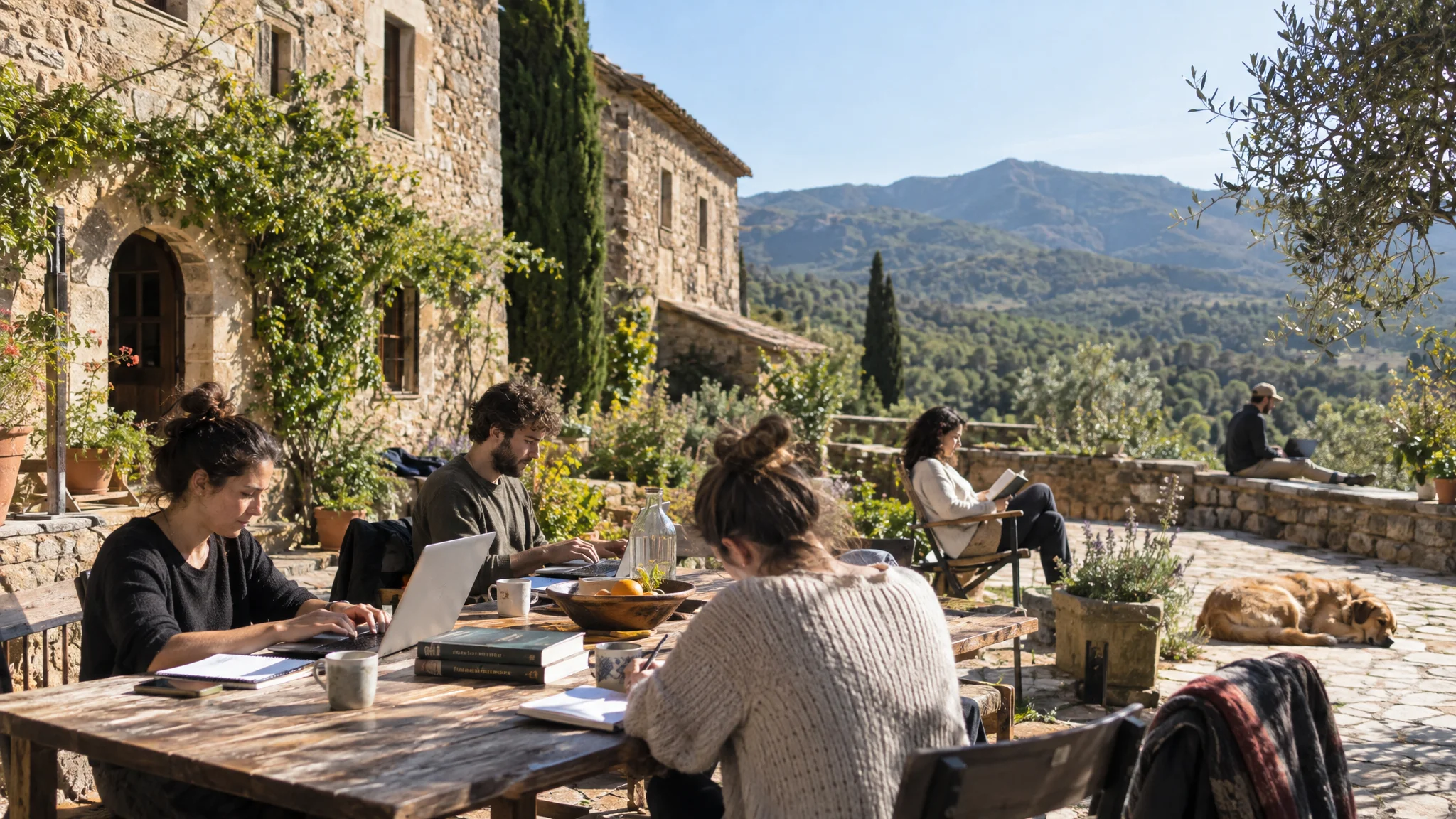
Every serious piece of creative work needs two things that ordinary life is structurally designed to deny it: uninterrupted time, and a place that does not ask anything of you. A creative retreat is the deliberate purchase of both. And Spain, specifically the rural, unhurried, oak-and-stone version of Spain, turns out to be unusually good at supplying them.
We know this from an angle most retreat guides do not have. We are not a retreat company. We run a coliving house in the Montseny, a fourteenth century masia an hour north of Barcelona, ten rooms and twelve to fifteen people, and over the last two years it has quietly filled with writers finishing manuscripts, painters who needed a wall and a north light, a composer who scored an entire short film in the room above the kitchen, and more than one person who arrived calling it a working holiday and left calling it the most productive month of their life. So this is written from the inside of the thing, not the brochure of it.
What a creative retreat actually is
A creative retreat is a stretch of time, usually one to four weeks, spent somewhere away from your normal life for the specific purpose of making work. That is the whole definition, and the important words are "specific purpose." A retreat is not a holiday where you also brought a notebook. The intention is the difference. On a holiday the work is what you do if there is time left over. On a retreat the work is the reason you came, and everything else, the food, the walks, the company, is arranged to serve it.
Retreats come in two broad shapes. The structured kind has a leader, a timetable, workshops, feedback sessions, and a group all working toward something together. The self-directed kind gives you the time, the space, the meals, and the quiet, and trusts you to know what to do with them. Both work. Which one suits you depends entirely on whether you want to be taught and held, or simply left alone with excellent conditions. Most of the people who come to us want the second, and had not realised until they arrived how rare it is to be given nothing but the right conditions.
Why rural Spain, specifically
The instinct is to book a retreat somewhere dramatic, a villa on a cliff, a converted monastery on a hill in Tuscany. Rural Spain competes on quieter and more practical ground, and the practical ground is what actually changes your output.
The cost is genuinely lower. A comparable stretch of time in the tourist-famous parts of Italy or southern France runs well above what the same weeks cost in the Catalan interior, where the landscape is just as good and the wine is cheaper. You can take a longer retreat, which matters, because the first few days of any retreat are spent decompressing and the real work only starts once the city has drained out of you.
The infrastructure is better than the romance suggests. Fibre internet reaches deep into rural Spain, including villages of a few hundred people, so a retreat here does not mean cutting yourself off from the research, the reference, or the occasional call your work needs. You get the isolation of the countryside without the helplessness of it.
And the country cooperates. More than 280 days of sun a year means a retreat here is not a gamble against weather. The light that painters chase is reliable. The long dry evenings that writers need are the default, not the exception.
The countryside beats the workshop hotel, and here is the mechanism
The reason a rural house outperforms a conference-style retreat venue is not aesthetic. It is structural, and it comes down to what surrounds the work.
A place with nothing to prove leaves you alone. There is no spa to feel you should use, no itinerary guilt, no sense that you are wasting an expensive booking by sitting at a desk all day. In a working house in a forest, sitting at a desk all day is simply what the house is for, and nobody blinks.
The walls hold quiet the way old stone does. A fourteenth century masia has thick walls and small windows and a kind of silence that modern buildings cannot manufacture. The forest outside absorbs the rest. For work that needs concentration, the acoustic environment alone is worth the trip.
The interruptions are removed at the source. No commute. No errands, because meals appear and the house runs itself. No small domestic decisions eating the edges of your attention. Every hour that ordinary life spends on logistics is handed back to you, and over a month those hours compound into the thing you came to finish.
And the landscape does the recovery work between sessions. Creative work is not sustainable in an unbroken block. It needs the pause where the subconscious catches up. A ridge walk over the Montseny, a run on an old fire road, an hour in the garden, these are not breaks from the work. They are the part of the work that does not happen at the desk, and the countryside supplies them at the door.
Alone, or among others
There is an old assumption that creative work requires solitude, and for some of it, in the deep-focus hours, that is true. But the best rural retreats solve a subtler problem, which is that pure solitude for weeks tips from productive into strange.
The version that works for most people is solitude during the day and company at night. You disappear into your work from morning to late afternoon, genuinely alone with it, and then you rejoin a dinner table of other people who spent their own day making something. There is a particular fuel in eating with a room of people who are all mid-project, none of them asking you to explain or justify what you are doing, all of them quietly understanding the specific weather of a working month. It is the model our house runs on, not because we designed it as an artists' colony, but because that is what happens when you put makers under one roof and feed them.
How to tell a real retreat from a holiday with good lighting
Before you book anything, three questions separate a genuine creative retreat from a nicely photographed break.
Is there a real place to work? A desk, a chair, good light, reliable internet, and somewhere you can leave your materials out overnight. If the only surface is a dining table that gets cleared for meals, it is a holiday.
Is the practical load actually lifted? A retreat should remove cooking, cleaning, and daily logistics, not add the admin of self-catering in a remote house. If you are doing your own shopping and dishes for three, you brought your normal life with you.
Is the time protected? The best retreats build the day around long uninterrupted work blocks and keep the social and the scenic to the edges. If the schedule is packed with excursions, it is a tour.
Get honest answers to those three and you will know exactly what you are booking.
Frequently asked questions
How long should a creative or writing retreat be? A week is enough to reset and make real progress on a defined piece. Two to four weeks is where a retreat turns into serious output, because the first few days are spent decompressing before the deep work starts. Longer stays are common in a coliving setting, where the retreat quietly becomes a way of living.
Do I need to be a professional artist or writer to go? No. Rural creative retreats host published novelists and first-time hobbyists at the same table. What matters is that you arrive with a project and the intention to work on it. Nobody checks your credentials.
Is rural Spain too isolated to get work done? The opposite, usually. Fibre internet reaches most of rural Spain, so you stay connected for research and calls, while the quiet and the removed distractions are exactly what deep work needs. Isolation is the feature, and it is a gentle one when there are other people in the house.
What does a creative retreat in rural Spain cost? Less than the famous alternatives in Italy or southern France. An all-inclusive room in a rural coliving in Spain typically runs 800 to 1,400 euro a month with workspace, utilities, internet, and often shared meals included, which is frequently cheaper than assembling the same setup in a city, and far cheaper than a branded retreat package.
Can I come for a creative retreat and still keep my job? Yes, and many people do. A retreat and a remote-work month are not mutually exclusive. Plenty of guests work their normal hours and use the evenings and weekends for their creative project, in a place built to make both possible.
Further reading
- Rural Coliving in Spain: The Real Thing, Not the Instagram Version, the deeper case for the countryside, with detail.
- Coliving in Spain: A Practical Guide to Your First Month, how arrival and setup actually work.
- Coliving in Montseny, the masia this article is written from.
- Coliving Near Barcelona, the case for basing an hour outside the city.