The Digital Nomad Lifestyle, Described by People Who Live Next to It
October 7, 2026
There is a photograph, and you have seen it. A laptop, open, on a sun lounger. A cocktail with a leaf in it. In the background, a beach doing what beaches do. Somewhere off frame, allegedly, a person is earning a full salary while their toes cool in the surf.
That photograph is the digital nomad lifestyle the way a menu photograph is dinner. Related. Optimistic. Not quite what turns up.
We can tell you what actually turns up, because we run a coliving house in the Montseny, an hour from Barcelona, and the digital nomad lifestyle happens in our building every single day. Ten rooms, twelve to fifteen people, a fourteenth century masia with fibre in the walls. We have watched hundreds of people live this life at close range, which is a very different thing from watching it through a phone. Here is the honest version, for anyone who has heard the phrase and wondered what the days are really made of.
First, the part the photo gets right
Let us be fair to the sun lounger, because the good parts are genuinely good and they are why people never go back.
Nobody tells you when to wake up. If your work is done, your Tuesday afternoon is yours, and you can spend it on a mountain instead of pretending to read email until five. You can live somewhere beautiful for the price of somewhere ordinary. You can be in a country whose language you are slowly learning, eating food that is better and cheaper than at home, and the whole time you are not on holiday, you are just living, with a salary landing every month. Over a year you see more, taste more, and meet more genuinely interesting people than most office lives deliver in a decade.
That is real. We watch it be real. The freedom is not a marketing invention. It is the actual product and it is worth a great deal.
Now, the part the photo leaves out
Here is what the beach photo cannot show you, because it is not photogenic.
You cannot actually work on a beach. Sand gets into the laptop, the screen is unreadable in sun, there is nowhere to sit properly, and the wifi is a rumour. Every experienced nomad knows the beach is for after work, not during it. The photo is a lie of staging, not of place.
The work still has to happen, and it happens on a normal schedule with normal deadlines. Being in Spain does not pause your Monday. If anything, the freedom makes discipline harder, because the entire country outside your window is more interesting than your spreadsheet, and no manager is watching to see whether you cave.
The logistics never stop. Someone has to find the next flat, understand the next country's rules, get a local SIM, locate a reliable dentist, figure out where to do laundry, and re-establish a gym, a barber, and a decent coffee in every new place. This admin is invisible in the photo and constant in the life. Nomads call it the tax you pay for the freedom, and it is a real tax.
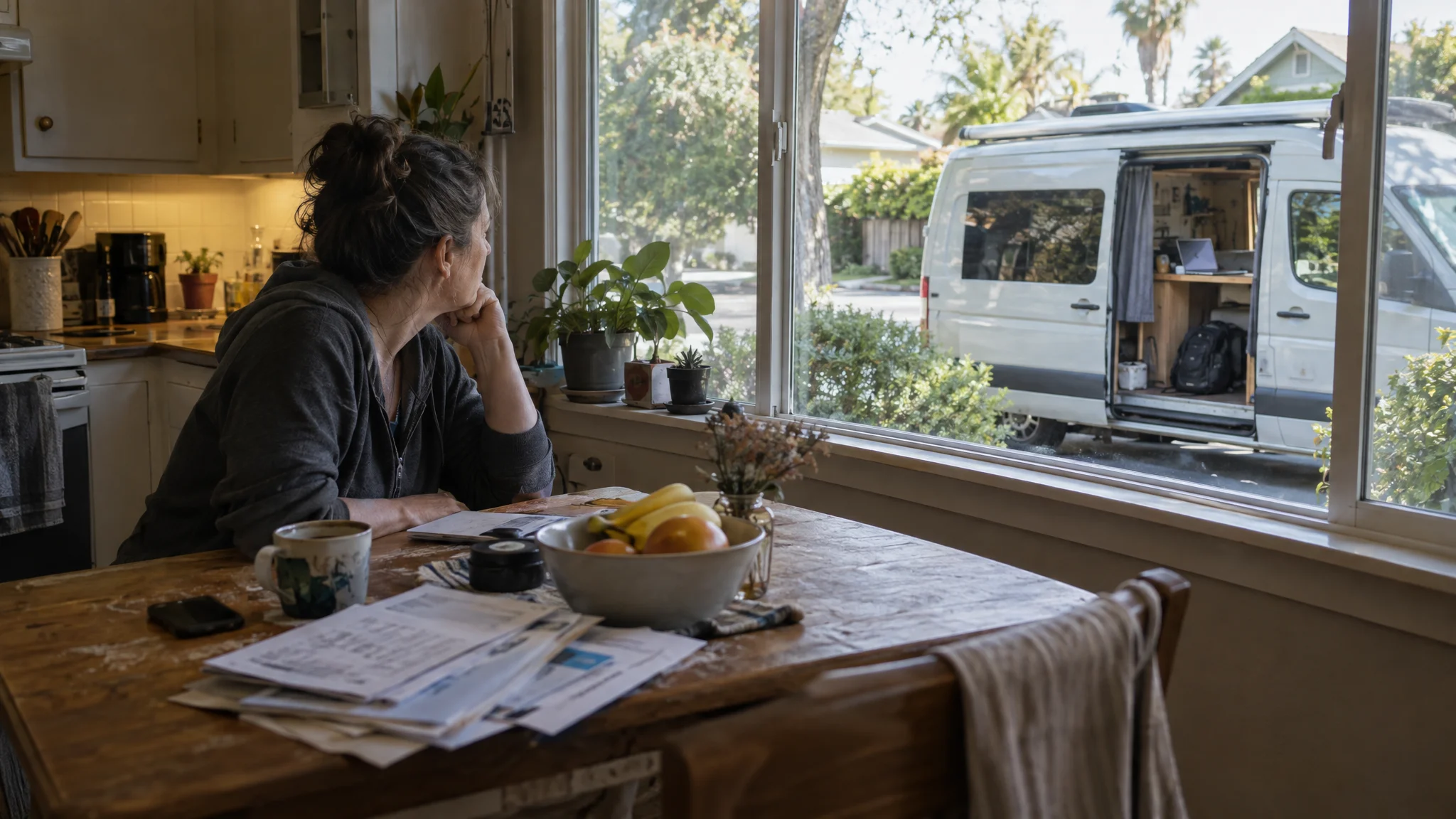
And then there is the quiet one. The lifestyle is, by default, lonely. This is the thing the photo hides most successfully. When you move every few weeks, your friendships are mostly made of goodbyes. You meet wonderful people in a hostel or a coworking space and three weeks later one of you leaves, and you promise to stay in touch, and you mostly do not. The freedom to go anywhere quietly becomes the difficulty of belonging somewhere. A lot of nomads hit this wall around month three and do not have a word for what is wrong.
What a real day actually looks like
Strip out the fantasy and the day is calmer and better than either the photo or the warning suggests.
You wake up without an alarm, or with a gentle one. You make coffee. You work a proper block in the morning, ideally at a desk and not on your bed, because the people who last at this learn early that the bed is for sleeping and the day falls apart without a real workspace. You break for a lunch that is longer and nicer than the one you used to eat at your keyboard. You work another block in the afternoon. And then, crucially, your evening is genuinely free, in a place you chose, and that is the whole reward.
The difference between a good nomad life and a grinding one is almost never the destination. It is whether there are other people in the day. The nomad who works alone in a rented studio and eats dinner over the sink is technically living the dream and quietly having a hard time. The nomad who works in a room with three other people, breaks for a shared lunch, and hikes with the house on Saturday is living the same dream with the loneliness engineered out of it.
That gap is the entire reason coliving exists, and it is why our house is full of people who tried the solo version first.
A week in the version that works
We are biased, obviously, but here is the shape of it when it goes right, drawn from a normal week in our own house.
You work your morning block at a real desk with fibre internet and oak forest through the glass. Lunch is on the terrace with whoever else is around, pasta someone made, wine that cost four euro and tastes like more. Afternoon block, then at five there is usually something, a walk up to a ridge, a run on an old fire road, a drive to the village for vermouth. Tuesday the whole house cooks dinner together and the conversation runs past midnight. Saturday you take the train into Barcelona, have the city for a day, and come home to quiet.
The trick, once you see it, is obvious. You get the freedom of the nomad life and the belonging of a settled one, at the same time, which the beach photo never promised because it could not fit both in the frame. People stay for months because of it. Some of them stop being nomads entirely and just move in, which we take as a compliment.
Is this lifestyle for you?
It suits you if you value autonomy over routine, if a beautiful ordinary Tuesday means more to you than a corner office, and if you are willing to trade some stability and some admin for a much larger life. It suits you less if you need a fixed community and a predictable week to feel like yourself, though even then there is a version, the semi-settled one, a base you return to between trips, that gives you most of the freedom and keeps the roots.
Our one honest piece of advice, from people who watch this life succeed and struggle in equal measure, is to not do the fully solo version for too long. The freedom is the easy part to get. The people are the part you have to arrange on purpose. Arrange the people, and the lifestyle in the photo finally becomes the lifestyle in real life, minus the sand in the keyboard.
Frequently asked questions
Is the digital nomad lifestyle actually relaxing? In parts. The evenings and weekends can be wonderful. The work is still work, with real deadlines, and the constant logistics of moving are a genuine effort. It is a bigger life, not an easier one, and most people who choose it would not trade back.
How much does the digital nomad lifestyle cost? Less than people fear if you avoid the expensive city centres. In Spain, a single person lives comfortably on roughly 1,300 to 2,200 euro a month depending almost entirely on where they base themselves. An all-inclusive rural coliving room often lands cheaper than a city studio once you add coworking, utilities, and feeding yourself.
Is it lonely? It can be, and this is the most underrated risk of the lifestyle. Solo nomads in rented flats hit it hardest. Basing yourself somewhere with built-in community, like a coliving, is the most reliable fix people have found.
Do you have to keep moving constantly? No. Many people who call themselves nomads actually move slowly, staying one to three months per place, or keep a home base and travel between. Constant motion burns people out. The sustainable version is slower than the word suggests.
Where is a good place to start? Somewhere with good infrastructure, a reasonable cost of living, and other remote workers already there, so the social side is not starting from zero. Spain is a common and easy first choice, and we make the case for it in our Spain for digital nomads guide.
Further reading
- What Is a Digital Nomad?, the plain definition, if you are still on the fence about the word.
- Spain for Digital Nomads, why everyone is here, and why most are doing it wrong.
- Coliving in Spain: A Practical Guide to Your First Month, how to skip the lonely studio phase entirely.
- Coliving in Montseny, the house this article keeps describing.